You lost the bidding war. But the comment you made — not to me or your realtor — made us accept your offer. It’s as if we understood each other without having met or spoken. As a matter of fact, the exchange of my property to you was practically poetic. But I’m a scientist. I don’t trust poetry. So I’ll just label it chemistry.
Before I go any further, I should preface by saying, although a scientist, I am, in no way, a chemist. I’m actually a high school teacher. I used to teach down the street from your new address, classes like Biology and Environmental Science. I really loved that job. I really loved that neighborhood; I loved that home, too. I believed it would last forever. That is until we had to move. But you already know all of this because papers were signed the day after Christmas, and the property was vacated on New Year’s day.
I’m writing because I heard your struggling in the neighborhood. But before we get into that, I need to address one thing. I also heard what you said about the light fixture in the kitchen. Just so you know, it’s the previous owner’s; I never got around to replacing it. I also heard you laid carpet to cover up the wood floors. I personally thought they gave character to the home, but, like you said, I guess they were old. Speaking of old, here’s a tip. The bathroom window sticks and makes a loud sound, like a fork scratching a cookie sheet, when opened. Be forewarned, because that window happens to be the perfect vantage point for a nosey little listen or peek, if you know what I mean.
Speaking of a little listen, I’ve been told you met some of the neighbors at the annual block party where the street ends and a parking lot begins. Yes, I heard about the DJ’ing incident. Don’t worry. No one will remember by next year. As a matter of fact, I wonder if some neighbors ever remember anything. I can’t tell how many times I had to answer the question What do you do for a living? to the same people at the same community gatherings over and over again. The conversation‘s always the same.
“You’re a high school science teacher?”
“Yes.”
“Is it true? Can a high school chemistry teacher make meth?”
“Technically, yes.”
“Do you know how to, uh, do chemistry?”
“Do you mean make meth?” At this point their eyes usually light up and they pull me away from the group. Then, head bobbing, they explain, in exhaustive detail, the entire five-season plot of a Netflix series, never noticing my gaze over their shoulder at the spontaneous conga-line snaking down the street. I’ve since learned to end these conversations quickly by darting my eyes right and left and lowering to a hushed whisper, “I’ll tell you how it works.”
“Really?!” At this point, I’m generally wedged between two parked cars with enthusiasm. I nod my head, wink, and then string together vocabulary I’ve managed to remember over the years.
“First, Methamphetamine is the dextrorotatory isomer of phenylisopropylmethylamine and the dissociation constants along with a positive ionization mode contribute to its collision energy of 35 eV…” It doesn’t take long for the centralized light in their eyes to dissipate and cloud over. Then they mumble an excuse to step away and release me. It works every time. I advise trying it next year.
The real kicker, though, I failed chemistry. I had to take it twice. I didn’t do so great the second time either. I’m not proud. NONE of my colleagues know this. I’ve eluded them over the years by flicking my hand and rolling my eyes in response to any question. “Chemistry?! I don’t dare touch that dark art,” with proclomation. The comment always sparks a light rolling chuckle, followed by a heeled thud of silence. I remain statue still with flared nostrils and an arched eyebrow until someone clears their throat and the meeting continues. It always works. No one understands art, yet no one will admit it.
Just like the neighborhood book club, for example. I’ve been told you attended your first meeting. Try not to take what happened personally. Lots of people freeze up when they’re nervous. You should have seen what happened with the cute new English teacher. The principal fired him a question about the school’s academic honesty policy. From across the table, my eyes briefly locked with his.
He stammered non-sensible syllables while pink streaks clawed up his cheeks. I wanted to recite it for him; I knew the code by heart; but I could only clutch my water bottle and bore eyes into the projector screen until our principal snapped, “Handbook policy number 7:241-S1. Read it.” The streaks clung to his cheeks for the rest of the meeting, and he never looked back up. I never released my water bottle in fear of exposing the sweat on my palms. When the meeting finished and everyone filed out, I scurried under his arm, eyes down, to get out of the way for the person he was holding the door open for.
I’m told your first book club went fairly similar; I’m also told you dashed out in a hurry without saying a word. I know what it feels like being around people who know a lot more than you. I almost quit the club after my first visit, too. But I need you to know, I’m glad I didn’t.
I had a student, once, whom my colleagues called The Virtuoso. His mental fortitude burgeoning at the edge of seventeen far surpassed mine in chemistry. Obviously. He didn’t even take chemistry at the high school. A car picked him up after lunch and whisked him to special classes somewhere else. He burgeoned beyond everything I had to offer in Biology, too, but a scheduling conflict landed him in my class. One day, ten minutes into a fifty-minute test, I watched him slide a pencil case into his bag and pull out a small, yellow book. I recognized the cover, so I slithered my way up and down the rows of test takers and hovered near until he looked up.
“I have to read that for my neighborhood book club,” I said, pointing. “Will you tell me what it’s about?”
“Who? Me?” His pupils shifted right and left. “Why?!”
“Well, alchemy; it’s like chemistry; it’s the title of the book.” He flipped the book over a couple of times and placed it on the desk. His expression remained still except for a slight tremor among his eyelashes.
“How am I supposed to know what it’s about?”
I grinned and held my fist in the air, “Hey! That makes two of us, then!” and motioned to receive a bump from his.
“It’s not in English. I’m reading it for Spanish homework.” He picked up the book, crossed his legs into a figure four, and continued with reading. I put my fist behind my back, then moved it to my pocket. Only then did I notice the title of the familiar, yellow cover actually read El Alquimista.
To be honest, I only approached in the hopes he’d give me a spark-noted version of the story so I could impress everyone at book club. Since he didn’t, I read The Alchemist (in English of course). Twice, actually. There are no big words; it’s a simple story; I don’t know why I just didn’t get it. So I arrived armed at the next club meeting with white wine and questions. I joined the circle orbiting a charcuterie board.
“I don’t understand what the book’s about.”
“How do you not understand?” a club member drawled over cured meat, “The author utilizes puerile diction as a means to compress his overarching thesis into allegorical archetypes comprehensible to the audience’s common denominator.”
“Oh,” I nodded. “So…that’s what it’s about?”
“No, dear,” the club member picked up a cube impaled by a foil-topped tooth-pick, “it’s about reading and following the omens.”
I’m still not sure that’s an accurate analysis, but I did learn a lot about omens from the conversation that night. For example, if a handbag is on sale, it’s the universe’s omen that it must be purchased. I also learned from the club that you can leave omens for others to follow, as well. Like texting links to your partner when you want expensive jewelry or manipulating the thermostat when you feel it’s time for a tropical vacation.
I am so glad I read and listened. Because when I had to sell my house in a matter of weeks, I recalled that little, yellow book and the lesson about omens, and decided to sprinkle a few among the staging decorations. Like the poster I framed and hung in the living room. It’s from this concert where Drew and I spun in the rain. I poised the record needle over the song we danced to at our wedding. Each of my children’s favorite books placed out on their perfectly made-up beds. In the kitchen I displayed a bottle of whiskey, distilled in Appalachia, and named after a blue peaked mountain. But it was my old, college copy of Walt Whitman that caught Drew’s attention.
“You’re reading poetry,” he commented and climbed into bed.
“What? This? No,” I joined him. “I’m using it for staging. I’m putting out all these little signs for the right buyer.”
“I don’t understand. You hate poetry.”
“True. But I like this one poem about boot soles: ‘Failing to fetch me at first, keep encouraged; Missing me one place, search another; I stop somewhere, waiting for you.’”
“I don’t get it.”
“I don’t either,” I said, giving him a peck on the cheek. “But I figure the right buyer will notice the little signs I’ve placed around the house and understand us. Maybe if they understand who we are as people, they’ll love the house as much as we did.” Drew returned my peck and turned off the light.
But here’s the crazy thing. Book club was right! You were the right buyer because you paid attention. You noticed every single sign. I know this because the next-door neighbor heard you say, “Too bad they’re moving cross-country. We would have been friends”. You followed it up with, “We have the same taste in books, booze, and music.”
When it came down to multiple offers, we chose you because of that comment. I read it as a sign you belonged there, in that home. I know it’s not going too well with the neighbors. I’ve heard the stories. You’re in a tight-knit community — it’s tough to break in. The people there tend to know a lot of things about everybody, and some of them, quite frankly, are cruel. But I don’t want you to give up just yet. I’m just a high school teacher. I can’t explain the chemistry, and I certainly am not going to attempt another poem. The best I can do is leave you some notes on how to survive the neighborhood.
Read carefully: It starts with the street vegetation. The syringa vulgaris on both sides of you are healthy and full. Their scent, when in full bloom, is so thick and sticky you can sip it with a spoon. Enjoy them. They take little maintenance, flower the longest, and have the most profoundly deep purple centers. Tend to the cercis canadensis to the east of the home. They’re a pleasant surprise, displaying a unique kind of beauty each season. Every year they get bigger and brighter, but not the kind of growth that’s hard to contain. Don’t waste your time with the magnolia virginianas in the front. They are fragile and frugal in flower; you’ll be lucky to catch one brief bloom. The quercus macrocarpa in the west park, keep your eye on them. I sounded the alarm my first year. I noticed the disease on the trunks and said they needed to be cut down before it spread. But no one listened. Those trees were still standing when we left on New Year’s Day.
As for the rosa multiflora directly south of the building. Don’t be fooled by that messy, capricious plant. In the spring, it can be breathtaking and alluring. Like a rash of little rockets lined up, peeping out of green cases, waiting to erupt in fuchsia, scarlet, and hot pink. But never in my studies or research have I seen a species from the rosaceae family like that. We made the mistake of tending to them too much in the beginning. I wish we hadn’t. They became all-consuming. It didn’t matter how much I pruned them, they were violent and ferocious in growing back. Drew gave up after the first year, but every spring I’d lean back on haunches, wipe dirt across beaded brow, exhale, and dig right back in with shears. I should have killed the plant, honestly. Maybe then it wouldn’t have lashed at our ankles like spiked whips every year.
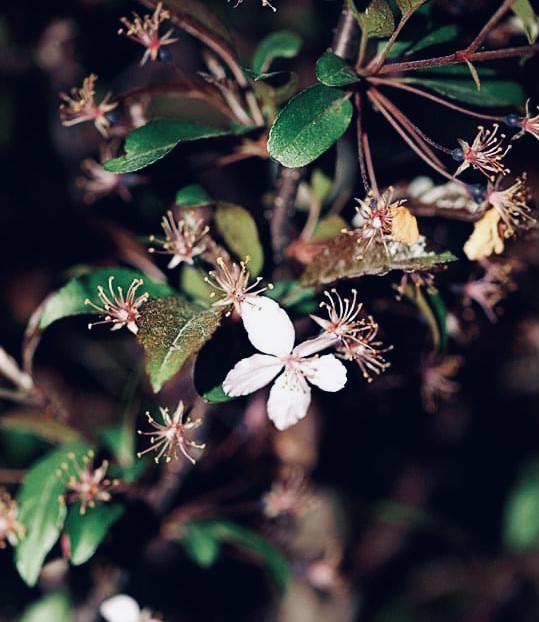
While we’re on the topic of vegetation, I do have one humble request. There is a tree in the southwest corner of the yard. Please don’t cut it down no matter what that neighbor says. She will complain the petals and leaves clog up the storm drain. She’ll tell you she has the city on speed dial; she’ll even give you the number of tree service companies offering discounts. But I planted that tree in memory of my son. He died as a baby. You’ll recognize the species. It blooms a billowing white thunder cloud, every spring, for his birthday.
I heard this is your first home. Congratulations. You probably don’t know, yet, what it’s like to have your husband sit you down at a table and say, “You’re not going to like what I’m about to say.” It feels like having your breath violently siphoned out through a hose, only to be replaced by a return of rushing fluid. You probably don’t know what it’s like to grip the table and watch the kitchen spin, seeing the walls that were supposed to be forever-walls centrifuging with the window blurring into the street lined with spinning one-hundred-year old trees in the community where you wanted to die teaching and realize… it’s all about to end.
I’m sure your view from the kitchen table is different. I’m sure you take your morning coffee with stillness, sipping the sunlight that filters through the window in slates and slices. I’m sure your view is full of hope, possibilities, and a promise to eventually change the light fixture. I’m sure you gaze out of that gauzy-framed kitchen window directly into your next-door neighbor’s window.
You’ll find her looking back. Don’t be alarmed. That neighbor — she’s legit. As for the others, well, it’s not my place to share judgement. You need to figure that out on your own. Although I have a feeling you — of all people — will study the notes and figure out my code.
Good luck
from a teacher
PS. Please share my letter. This could be for the neighbor three doors down from you.
 No Real Balance